
 Above: One of the original logos for Eichler Homes
As an architecture lover and a modern design maven, I was fortunate enough to grow up in Northern California, an area where many Eichler homes were built. I had friends who grew up in them, I attended 'keggers' in many of them and sneaked cigarettes while parked in cars in front of them.


I've been familiar with them for over 30 years and since I didn't really know the history behind them, I assumed most people were. Of course, now that I'm older- and a wee bit wiser (I no longer sneak cigarettes in parked cars)-- I realize that with the resurgence of mid-century modern, many people from outside California have no idea what an Eichler Home is.
What exactly is an "Eichler" home?Joseph Eichler founded Eichler Homes, Inc. in 1949 and pursued his vision of creating modern homes with architecturally distinct elements for the average family (and average income!).
 Some classic examples of Eichler architecture: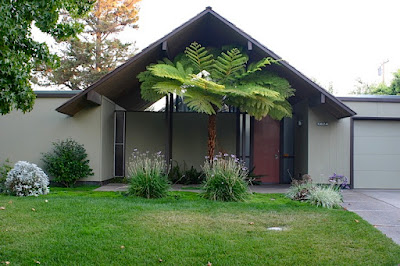


 Who was Eichler anyway?
above left: Joseph Eichler at work and right; in 1972
JOSEPH EICHLER: Developer who made a differenceMary Jo Bowling, Special to The Chronicle
Saturday, August 26, 2006
Joseph Eichler was a developer with a plan: He wanted to make high-style, modern home design affordable for the masses. The idea reportedly came to him while he was living in a Frank Lloyd Wright house in Hillsborough.
"Developing homes was a second career for him," said architect Paul Adamson, who, with Marty Arbunich of the Eichler Network, wrote a book about Eichler homes. "He wanted to bring some of the same features of that house, such as indoor-outdoor living, to the middle class."
In 1950, after experimenting with some prefab projects, Eichler hired the Bay Area architecture firm of Anshen and Allen (later he also worked with architects A. Quincy Jones and Frederick E. Emmons) to create an affordable modern home.
At the time, it was unprecedented. No other developer wanted to spend the money to have tract homes designed by architects. "The firm came up with houses that had an open plan, post and beam construction, whole walls of glass, and radiant heating," said Adamson. "Those were the kinds of things you might find in an expensive, custom-built home at the time, but certainly not in a house for the masses."
 Above: A 1950 advertisement in the Daily Palo Alto Times newspaper for Eichler homes. Price was $9,400.
Adding features such as sliding glass doors and skylights to the suburban homes springing up all over the country contradicted the ideas most developers had about how to make a profit.


Above: The back side and interior of an Eichler home in Terra Linda, CA.
Through careful refinement, Eichler was able to hone his manufacturing process to produce the homes in a cost-efficient way. "It was like an assembly-line process," said Adamson. "He had the home parts constructed at a central location and then shipped to the building site. He also made use of standard building materials in a creative way."
Eichler launched an aggressive and sophisticated marketing campaign to introduce his houses to the American public. To many people, accustomed to more traditional houses, the flat-roofed homes must have looked unusual.
Advertisements featuring the photography of Ernest Braun (see his photos, available for purchase, later on in this post) helped demonstrate how the houses worked by showing models posing as homeowners in the house. "No one had ever done that before," said Adamson, whose book, "
Eichler: Modernism Rebuilds the American Dream," features many Braun photographs. "Most architectural photography was stark and cold. These ads made the homes look warm, livable and desirable."

Above: Eichler: Modernism Rebuilds the American Dream by Paul Adamson and Marty Arbunich, 2002,
Buy the book, Eichler: Modernism Rebuilds the American Dream
Although the homes were never popular on a wide scale, they were a smash with a certain audience. "An interesting subset of people -- engineers, architects, and modern art and design lovers -- were intrigued by the homes," said Adamson. "They found their streamlined look and the way they expand into the garden appealing."
Like most home styles, Eichlers have fallen in and out of favor. Today, with the current obsession with modern design, they appear to be more popular than ever. It's the original ideas that have stood the test of time: open-plan living with living room, dining room and kitchen connected; the blurring of the lines between indoors and outdoors with atriums, window walls, skylights and sliding glass doors; and leaving the construction visible -- i.e. the ceiling beams and boards. The classic Eichler materials have even come back into vogue: Radiant heating, cork floors, wood paneling and vinyl tile have all experienced a recent surge in popularity.
Of course, Kathleen Haley, whose first-person essay "Unhappy With Eichler'' (Home&Garden, July 29) touched off a flurry of protest letters and blogs, is not alone in her complaints. Conventional (and some would say misguided) wisdom claims that flat roofs leak, dark walls (many Eichlers have mahogany paneling) make rooms dark, and the houses are too small. Among the answers Eichler devotees have is a simple one: maintenance. "These houses were constructed with inexpensive materials over 30 years ago," said Adamson. "Almost any material will wear out over time."
"Flat roofs need to be maintained if you don't want them to leak," said Loni Nagwani, an Eichler owner and real estate agent specialist. "If you don't take care of them and clean out the downspouts, they will leak sooner or later." Nagwani also advises her clients who want more light to add skylights.
Tom Borsellino, a San Jose Eichler owner, has a more basic solution: Keep the greenery trimmed. "A lot of people allow plants and trees to grow over the big windows," he said. "Of course, then it will be dark. The answer is to keep things pruned."
Adamson also points out that remodeling or updating an Eichler gives a homeowner a chance to add more energy-efficient glass and insulation.
What would Eichler think if he could see his homes today? Adamson believes that the developer believed that his work was important and would be happy to see people still devoted to his ideas, although he might not be so happy about some of the color and material choices. "There's a story I've heard that said Eichler was driving around one day when he spotted someone repainting one of his houses," said Adamson. "He supposedly got out of the car and told him to stop ruining the house."
Want to just see some Eichler homes?
Try going here.
And of course,
The Eichler Network where you can learn much about Eichler homes, history, renovation and more.
Ernest Braun's original photos of early Eichler homes:(Please click on the images below to enlarge)


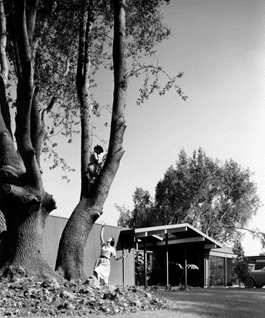


Photographer Ernie Braun's black and white photos shown above of Eichler homes are available for purchase, either
online here, or send order with check or money order payable for $285 plus $7 postage & handling, and 8.5% CA sales tax, if applicable, for each print to:
Eichler Network Sales
P.O. Box 22635
San Francisco, CA 94122
Each order includes exquisite printing & framing, 16"x20" custom print, 2-inch matt with French line, black wood frame, plexi-glass. (Allow three weeks delivery.)
Where can you buy an actual Eichler home?
Eichler Homes for Sale:

 Find Eichler Homes For Sale in Los Angeles, Orange County and San Fernando Valley here.Eichler Homes in Marin County
 Eichler Homes in San Francisco and Northern California
Renee Adelmann, Realtor + Eichler Owner, Marin Modern Real Estate / Keller Williams Realty, SF Properties, Phone: 1-415-EICHLER (342-4537)
www.MarinModern.com and
www.EichlerforSale.com EICHLER HOME PAINTINGS
If you can't afford an actual Eichler home, perhaps
Danny Heller's paintings and studies of them would be just the thing. A Southern California artist, Danny is known for his fabulous paintings of suburbia. He has a special series of Eichler Home paintings and studies that are simply wonderful and surprisingly affordable.

above: Danny Heller, Eichler House With Motorcycle, o/c, 22x42," 2008, $3,400

See Danny's Eichler paintings at
Terrence Rogers Fine Art Gallery Above: An example of one of Danny Heller's Suburbia paintings
In the artist's own words:
My latest body of work focuses on the Modernist tract homes created by California-based architect Joseph Eichler (1900-1974). This visionary architect pioneered suburban planned communities, thus changing not only the California lifestyle, but also the California aesthetic. These homes featured open floor plans, post-and-beam construction, and spacious atriums, amongst other innovative designs, that defined exclusive tracts in the Bay Area and Los Angeles.
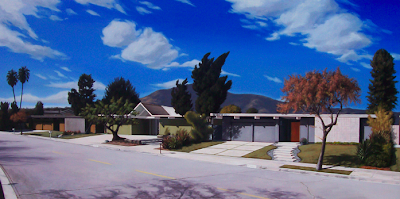
above: Eichler Neighborhood, o/c, 36x72," 2008

above: Eichler Carport Interior #1, o/c, 36x48," 2008

above: Eichler With House Automobiles, o/c, 19x38," 2008, $3,000
In addition to his paintings, Danny sells these fabulous "studies":


Above: Close-up of Study #6
Danny Heller's paintings have been exhibited in solo and group shows throughout California, spanning from Santa Barbara to San Diego, and most recently at Hollywood’s La Luz De Jesus Gallery. The variety of collectors who have sought out his work are a testament to the artist’s success. Some have purchased work featuring familiar locations, while others collect purely for the artwork’s inherent formal qualities. In either case, many will admire Danny Heller’s upcoming “Suburbia” series that captures the quirky, mid-century tract housing of the San Fernando Valley.
Go to Danny's Site and see his wonderful paintings for yourself here.Vintage Eichler Brochures:


You may be able to find some vintage Eichler brochures for sale on ebay or at
Popluxe books.Books On Eichler Homes:
 Buy these and other Eichler books here


 The Clearview Dollhouse
 Dollhouse Reproduction Of Arne Jacobsen 1928 Villa
 M112 PODS & Mini Modern Furnishings By Paris Renfroe
 Modern Interior Design. On a Different Scale.
 Mark Turpin's Pine Island: Architecture In Miniature
 Bauhaus Mini-modernist Doll Houses Promote Resene
 Kathy Osborn's Bauhaus Dollhouse


